Ulu vs Mezzaluna: The Quick Answer
An ulu and a mezzaluna knife are both curved, rocking blades, but they differ in origin and grip. The ulu comes from the Arctic and has one handle centered above the blade, so you use it with one hand. The mezzaluna comes from Italy and usually has a handle at each end for two-handed rocking. Both mince beautifully; the ulu is more versatile, while the classic mezzaluna excels at fine herb work.
Below we compare the two side by side — history, design, how they cut, what each does best and which one fits your kitchen. We also cover the “mezzaluna-style ulu,” a hybrid that combines the best of both.
What Is a Mezzaluna Knife?
“Mezzaluna” is Italian for “half moon,” which describes the blade perfectly. A traditional mezzaluna knife has a curved blade with a handle on each end. You hold one handle in each hand and rock the blade back and forth across the cutting board. It has long been a fixture of Italian kitchens, where cooks use it to mince herbs, garlic and vegetables for sauces, soups and pestos.
Mezzalunas come in a few varieties:
- Single-blade mezzaluna: one curved blade with two handles. The most common and easiest to clean.
- Double-blade mezzaluna: two parallel curved blades that cut twice with every rock, for very fast mincing.
- Single-handle mezzaluna: one handle across the top, closer in feel to an ulu.
- Mezzaluna with bowl board: sold as a set with a concave board that keeps herbs contained.
For a deeper look at the single and double styles, see our guide to single vs double mezzaluna.
What Is an Ulu Knife?
The ulu comes from the Indigenous peoples of the Arctic, who have used it for thousands of years. It has a wide crescent blade with a single handle centered above it. You grip the handle from the top with one hand and rock the blade through food. Traditionally an all-purpose household tool, today it is a popular kitchen knife for herbs, vegetables, cheese, cooked meat and pizza. Learn more about its background in the Alaska ulu: history and how it’s used today.
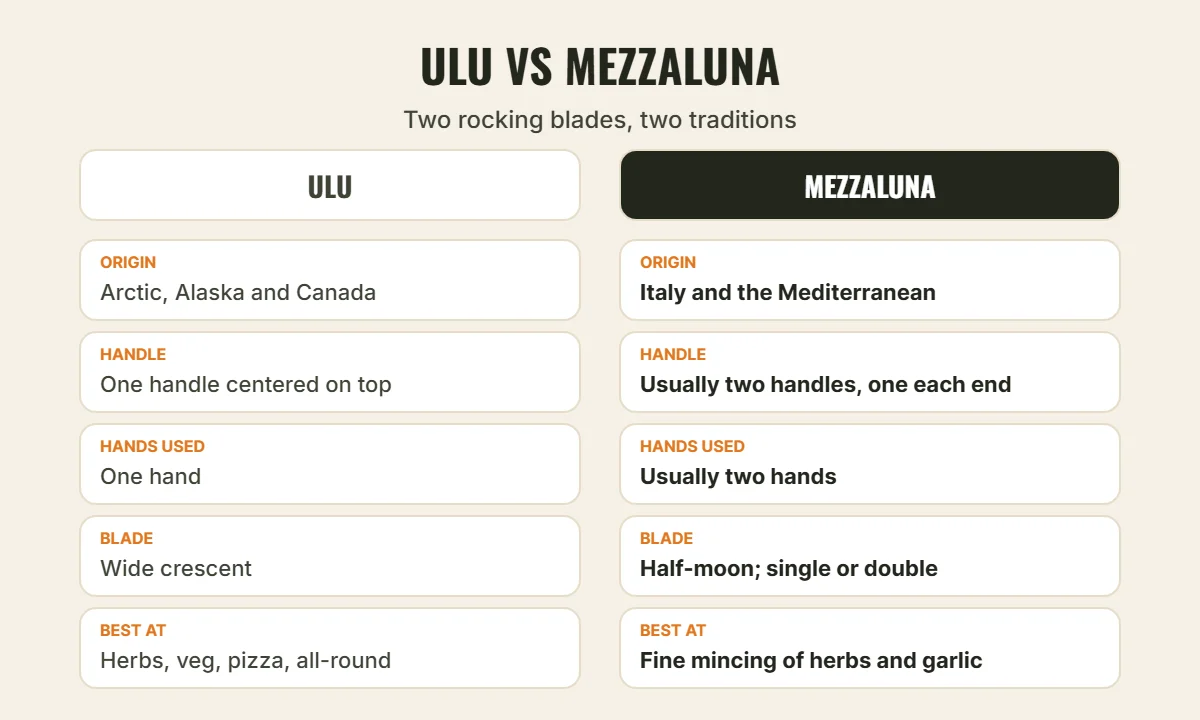
Ulu vs Mezzaluna: Side-by-Side Comparison
| Feature | Ulu | Mezzaluna Knife |
|---|---|---|
| Origin | Arctic (Alaska, Canada, Greenland) | Italy and the Mediterranean |
| Handle | One handle centered over the blade | Usually two handles, one at each end |
| Hands used | One | Usually two |
| Blade options | Single crescent, many sizes | Single or double blade |
| Free hand | Available to steady the board or gather food | Both hands on the handles |
| Best tasks | Herbs, vegetables, pizza, cheese, general prep | Fine mincing of herbs, garlic, nuts |
| Pizza cutting | Excellent with a larger blade | Good with a wide single blade |
| Storage | Compact; often comes with a sheath | Wider due to two handles |
| Cleaning | Easy | Easy (single) to fiddly (double) |
Key Difference 1: The Handle
The handle is the biggest difference. An ulu’s single, centered handle puts your hand directly over the blade. Pressure travels straight down, and your other hand is free to steady the board, hold food or scrape chopped ingredients back into a pile.
A two-handled mezzaluna asks for both hands, one on each end. That gives a very even, balanced rocking motion and keeps both hands far from the edge, which many people find reassuring. The trade-off is that you cannot hold the food or board while you chop.
Key Difference 2: How They Cut
Both knives rock, but the feel is different. With an ulu, you rock by pressing down through the center and tilting from one tip to the other, like rocking a cradle with one hand. With a two-handled mezzaluna, you push down alternately on the left and right handles, like a seesaw.
In practice, the mezzaluna’s seesaw motion is very fast for producing a fine mince in one area, especially with a double blade. The ulu’s one-handed rock is more flexible: you can mince, dice, slice pizza and cut cheese with the same tool and the same motion.
Key Difference 3: Versatility
A classic mezzaluna is a specialist. It is superb for herbs, garlic, nuts and soft vegetables, but less handy for slicing, pizza or cutting larger items. An ulu is a generalist. It handles the same mincing jobs well and adds pizza, flatbreads, cheese, cooked meat and everyday chopping.
Key Difference 4: Size and Storage
Ulus are compact. With one handle on top, they fit easily in a drawer, often in a leather sheath. Two-handled mezzalunas are wider because of the handles on each end, and double-blade versions are bulkier still.
What Each Knife Does Best
Choose a Mezzaluna For…
- Large quantities of finely minced herbs for pesto, gremolata or salsa verde
- Two-handed control that keeps both hands away from the blade
- Using with a matching bowl board
Choose an Ulu For…
- One tool that minces, dices, slices and cuts pizza
- Keeping one hand free to steady the board or gather food
- Compact storage and easy cleaning
- A gift with a great story and a striking look
The Best of Both: The Mezzaluna-Style Ulu
Some knives blend the two designs: a mezzaluna-shaped blade with a single ulu-style handle on top. You get the fine-mincing curve of a mezzaluna with the one-handed control and versatility of an ulu. It is an excellent choice if you mainly chop herbs and vegetables but still want something that can handle a personal pizza.
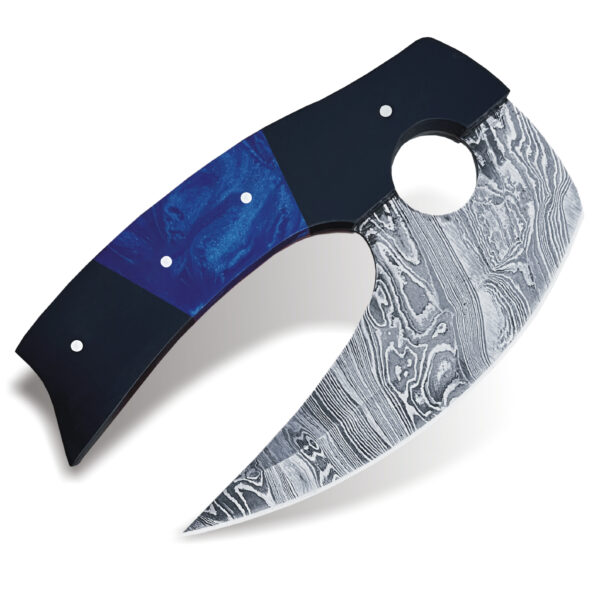
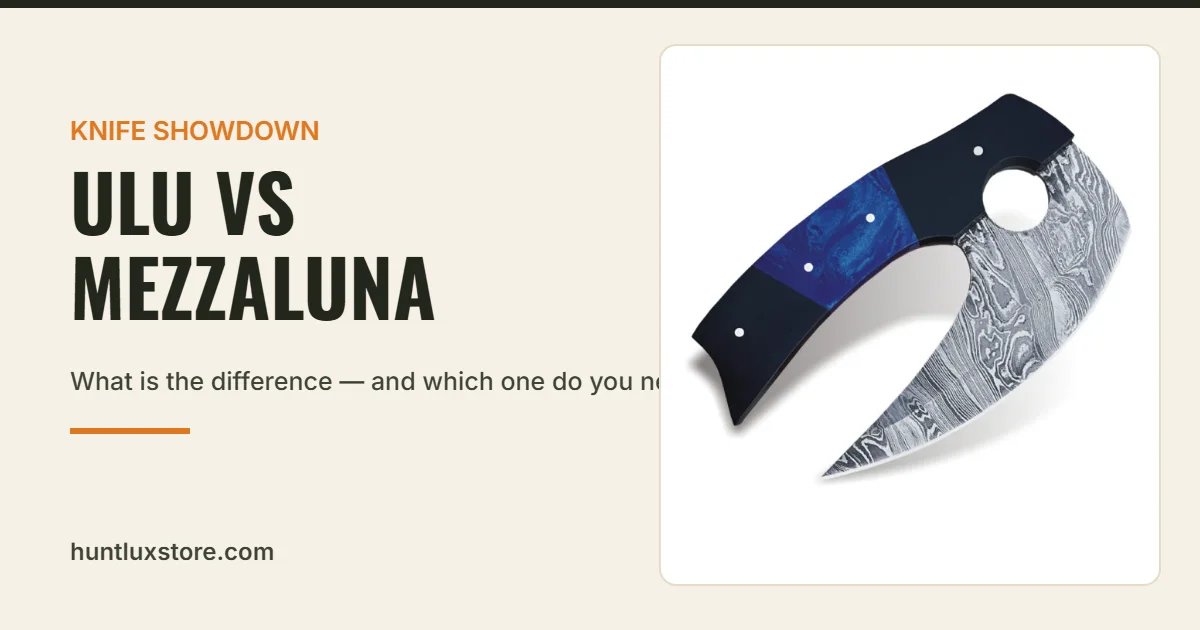
Our 5.4-inch Damascus mezzaluna ulu is exactly this kind of hybrid: a mezzaluna-shaped blade with a single top handle in blue-and-black resin. Quick for herbs and garlic, comfortable for everyday prep, and it comes with a leather sheath.
- Damascus Mezzaluna Ulu Knife – 5.4″ Rocking Herb Chopper with Sheath, Blue & Black Resin Handle Original price was: $64.50.$34.50Current price is: $34.50.
- Mezzaluna-style ulu knife with a 5.4″ Damascus steel blade
- Minces herbs, garlic and veggies fast with a rocking motion
- Blue & black resin handle with leather sheath
BUY 2 ULU KNIVES, SAVE 15% – mix any styles, discount applies in cart.✈Free US Shipping
On orders $49+, otherwise $7.99↺14-Day Returns
Unused, with sheath & packaging✓Leather Sheath Included
Safe storage for the blade✉Questions?
Contact us – we reply fast
Buy 2 ulu knives, save 15%.
How to Use Each Knife
Using an Ulu
- Grip the handle from above with one hand.
- Set the curve on a wooden or plastic board.
- Rock from tip to tip with light, steady pressure.
- Use your free hand to steady the board or gather food back into a pile.
- Scoop chopped food with the blade face.
Using a Two-Handled Mezzaluna
- Hold one handle in each hand.
- Place the blade over the pile of herbs or vegetables.
- Press down alternately on each handle in a seesaw motion.
- Lift and gather the food back into a pile as needed, then continue.
Both work best on a stable wooden or plastic board. For tips on choosing one, read our mezzaluna cutting board guide.
Caring for Ulus and Mezzalunas
Care is the same for both. Hand wash with warm water and mild soap, dry immediately, and never use the dishwasher. Oil carbon or Damascus blades lightly now and then, and store the knife in a sheath or guard. On a double-blade mezzaluna, use a small brush to clear food from between the blades. For sharpening a curved edge, see our ulu knife guide.
A Short History of the Mezzaluna
The mezzaluna has been part of Italian home cooking for generations. In kitchens where fresh herbs, garlic and vegetables are the base of so many dishes, a tool that could mince large amounts quickly and evenly was invaluable. The half-moon shape let cooks work a pile of parsley or basil down to a fine, even texture without bruising it, and the two handles gave a steady, balanced motion.
Over time the mezzaluna spread across Europe and beyond, and makers created variations: double blades for faster mincing, single handles for one-handed use, and matching wooden bowl boards. Today it is a familiar tool in home kitchens around the world, often sitting right beside the cutting board.
Recipes Where Each Knife Shines
Pesto and Herb Sauces
Basil pesto, salsa verde and chimichurri all start with a big pile of herbs. A two-handled or double-blade mezzaluna chops a large batch very quickly. An ulu works just as well for smaller batches, and you can use your free hand to keep pushing the herbs back under the blade.
Gremolata and Garnishes
Parsley, garlic and lemon zest minced together need a fine, even texture. Either knife does this beautifully. Rock slowly and turn your angle every few passes.
Chopped Salads
Load greens, vegetables and toppings onto a large board and rock through them. An ulu’s wide blade also scoops the salad straight into the bowl.
Pizza and Flatbreads
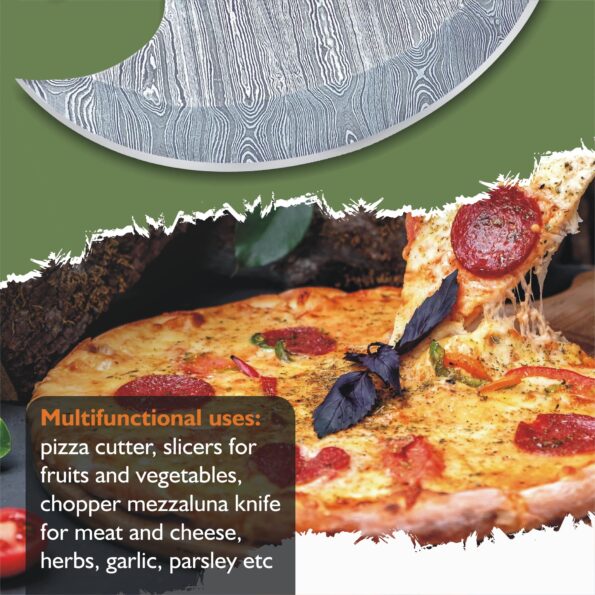
This is where an ulu clearly pulls ahead. A larger ulu or a wide pizza rocker slices a whole pie in a few clean rocks. Read why in our guide to the mezzaluna pizza cutter.
Nuts and Dried Fruit
Both knives chop nuts evenly without sending pieces flying, especially on a bowl board. Rock gently for a coarse chop or keep going for a fine crumb.
Cheese and Cooked Meat
An ulu cuts blocks of cheese, cooked chicken and roasts neatly thanks to its wide blade and downward pressure. A classic two-handled mezzaluna is less suited to these jobs.
Common Mistakes With Rocking Blades
- Lifting and chopping: keep the edge on the board and rock. Lifting high wastes effort and gives an uneven cut.
- Using a glass or stone board: these dull the edge fast. Use wood or plastic.
- Chopping wet herbs: dry them first so they do not stick and turn mushy.
- Pressing too hard: a sharp blade needs only light, steady pressure.
- Leaving the blade wet: always dry it right away, especially Damascus or carbon steel.
Ulu vs Mezzaluna Buying Checklist
- How many hands do you want to use? One — choose an ulu. Two — choose a classic mezzaluna.
- What will you cut most? Mostly herbs — either works; herbs plus pizza, cheese and vegetables — choose an ulu.
- How much storage space do you have? Limited — an ulu with a sheath is the compact choice.
- Do you want a gift? A Damascus ulu with a striking handle and leather sheath makes a memorable present.
- Blade steel: stainless for easy care, Damascus for character and a keen edge. Compare them in stainless steel vs Damascus ulu knife.
Who Should Choose Which?
| If you are… | Best pick |
|---|---|
| A home cook who wants one versatile rocking knife | Ulu |
| A herb lover making big batches of pesto | Two-handled or double mezzaluna |
| A pizza fan | Large ulu or pizza rocker |
| Short on drawer space | Ulu with sheath |
| Looking for a gift | Damascus ulu |
| Wanting fine mincing with one hand | Mezzaluna-style ulu |
Safety Tips for Ulus and Mezzalunas
- Stabilize the board with a damp towel or non-slip mat before you start.
- Keep fingers behind the curve: with an ulu, use your free hand on the far edge of the board, never in front of the blade.
- Never catch a falling knife: step back and let it drop.
- Wash it on its own: do not leave a curved blade hidden in a sink full of soapy water.
- Sheath it after use: a sheath protects both the edge and your hands in the drawer.
Left-Handed or Right-Handed?
Both knives suit either hand. An ulu’s centered handle is symmetrical, so left- and right-handed cooks hold it the same way. A two-handled mezzaluna uses both hands equally. If you are left-handed and have struggled with some kitchen knives, a rocking blade is an easy, comfortable choice.
Cleaning Tips
A single blade wipes clean in seconds: wash, rinse and dry. A double-blade mezzaluna needs a little more attention, because herbs and garlic can lodge between the blades. Rinse it straight after use and run a small brush between the blades before food dries. Whichever you choose, dry it fully before storing.
Ulus and Mezzalunas as Gifts
Both knives make thoughtful gifts for people who love to cook. A classic two-handled mezzaluna with a bowl board suits a dedicated herb lover. An ulu suits almost anyone — home cooks, pizza fans, new homeowners — because it handles so many jobs. A Damascus blade with a distinctive handle and a leather sheath turns either one into a present that feels special and gets used every week.
Our Picks
Best All-Round Ulu
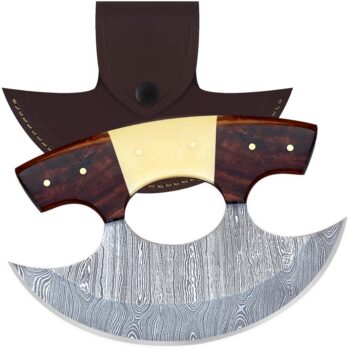
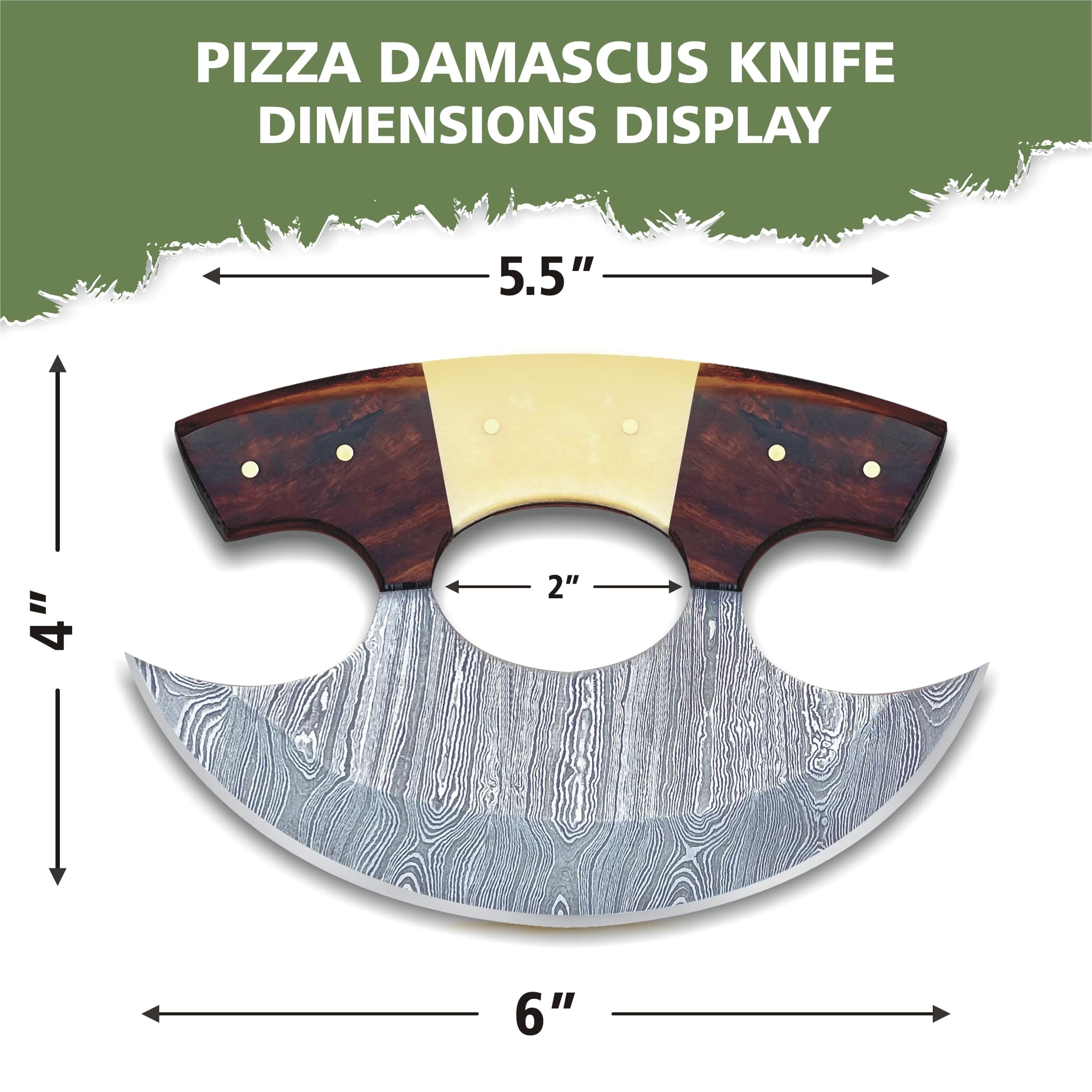
A 6-inch Damascus ulu with a camel bone and wood handle. It does everything a rocking blade can do, from herbs to pizza, and makes a memorable gift.
- Damascus Ulu Knife with Sheath – 6″ Alaskan-Style Kitchen Chopper, Camel Bone & Wood Handle Original price was: $59.95.$29.99Current price is: $29.99.
- 6″ Damascus steel ulu blade with a natural camel bone & wood handle
- Rocking cut for pizza, herbs, vegetables and cooked meat
- Comes with a leather sheath – ready to gift
BUY 2 ULU KNIVES, SAVE 15% – mix any styles, discount applies in cart.✈Free US Shipping
On orders $49+, otherwise $7.99↺14-Day Returns
Unused, with sheath & packaging✓Leather Sheath Included
Safe storage for the blade✉Questions?
Contact us – we reply fast
Buy 2 ulu knives, save 15%.
Best for Pizza Night
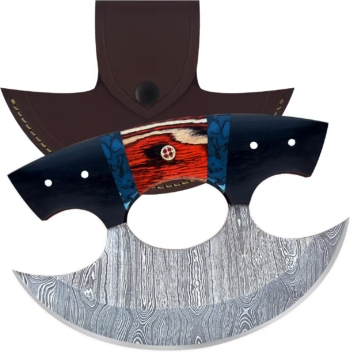
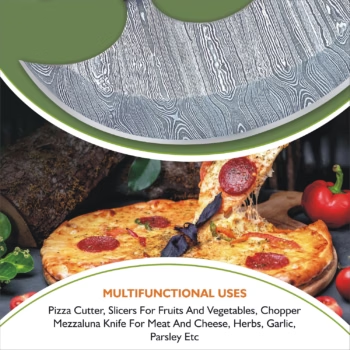
A wide Damascus rocking pizza cutter with a resin-and-wood handle, built for clean slices without dragging the cheese.
- Ulu Rocking Pizza Cutter – 6″ Damascus Steel Ulu Knife with Sheath, Resin & Wood Handle Original price was: $54.95.$32.70Current price is: $32.70.
- Rocking pizza cutter and ulu knife in one – 6″ Damascus steel blade
- Slices pizza in a single rocking motion, no dragged toppings
- Resin & wood handle with leather sheath
BUY 2 ULU KNIVES, SAVE 15% – mix any styles, discount applies in cart.✈Free US Shipping
On orders $49+, otherwise $7.99↺14-Day Returns
Unused, with sheath & packaging✓Leather Sheath Included
Safe storage for the blade✉Questions?
Contact us – we reply fast
Buy 2 ulu knives, save 15%.
See every size in the ulu knife collection.
Final Tips Before You Buy
Hold the knife if you can, or check the blade size and handle details carefully online. Make sure it comes with a sheath or guard, and choose a steel that matches how much care you want to give. Whichever style you pick, a sharp, well-made rocking blade will speed up your prep every day.
Frequently Asked Questions
Still have a question? Contact us — we’re happy to help.
Which One Should You Buy?
If you want one tool that does nearly everything — herbs, vegetables, cheese and pizza — choose an ulu. If you mostly mince big piles of herbs and like a two-handed grip, a classic mezzaluna is a lovely specialist. And if you want a bit of both, a mezzaluna-style ulu gives you the fine-mincing curve with the ease of one hand.
Explore handmade Damascus ulu and mezzaluna knives at Huntlux. Every knife comes with a leather sheath, US orders over $49 ship free, and buying two saves you 15%.
ABOUT THE AUTHOR
The Huntlux Team
We make and sell handmade Damascus steel ulu knives, each shipped with a leather sheath, and personalized chef knife sets made to order. Our guides come from what we see every day: the questions customers ask before they buy, and how they actually use their ulus for herbs, pizza and everyday meal prep. Huntlux ulu knives are sold here on huntluxstore.com and on Amazon.
Shop this guide: mezzaluna ulu knife in blue and black resin